
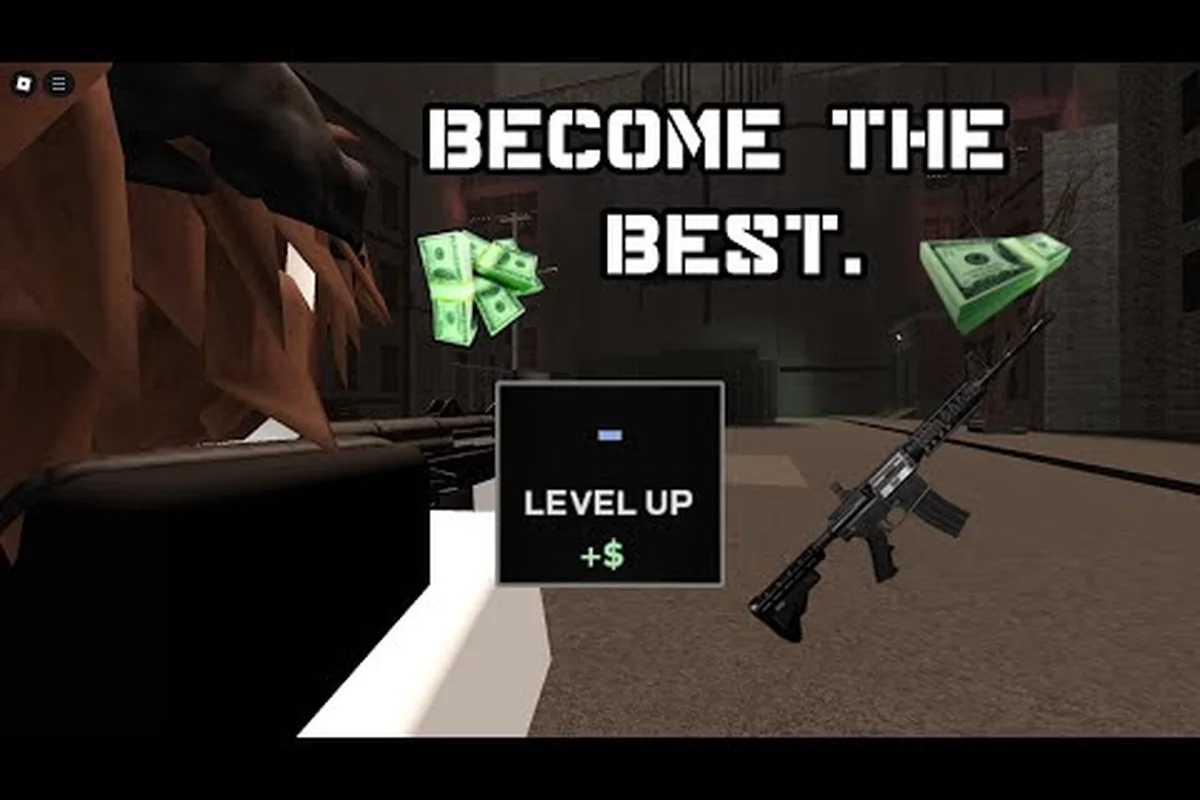
Criminality’s core loop connects Cash, loadout upgrades, and combat performance: earning money lets you buy better Gear, while stronger weapons and armor improve your odds in fights. Movement matters because strafe distance, sprint stamina, and positioning can determine whether a fight ends in a kill or a retreat. The free-to-play structure means progression depends on matches rather than a paid unlock schedule, so beginners should prioritize affordable Gear, avoid risky cash runs, and learn when disengaging is more profitable than fighting. Private servers offer room to test loadouts and movement patterns, but they should not be confused with official progression or account advantages. Exact weapon statistics are omitted here where reliable values are not published.
Understanding Criminality How It Works
Criminality is built around a cash-in, gear-out, fight progression loop. Cash comes from several activities, including allowance, bounties, loot drops, cash drops, scraps, mystery crates, and supply drops. Players then spend that money in the armory store or convert it into dealer points before entering combat.
That loop matters because gear and cash support one another. A better weapon can help you win fights, successful fights can lead to more cash, and that cash can eventually fund stronger equipment. However, the developers have not published official damage, fire-rate, magazine-size, range, XP-rate, level-cap, or bounty-value figures. Any guide that presents precise numbers for those systems should be treated cautiously.
| Part of the loop | What the player does | Why it matters |
|---|---|---|
| Earn cash | Collect allowance, bounties, drops, scraps, crates, and supplies | Builds the budget for equipment |
| Equip gear | Buy items through the armory store | Adds better options for future encounters |
| Improve standing | Convert money into dealer points | Supports progression through the economy |
| Enter a fight | Use movement, attacks, dodges, and weapons | Tests the gear you have earned |
| Repeat | Reinvest rewards into stronger gear | Creates the central gameplay loop |
The Free-to-Play Structure
Criminality free to play refers to the fact that its core gameplay can be accessed without a paid purchase, according to the game's official Roblox information. The experience is centered on joining a server, earning in-game resources, and improving your setup over time. Free access does not mean every match has the same rules, because private servers can enable or disable many mode-specific options.
The important distinction is between access and spending. Robux may be available through optional storefront features, but the core loop is built around in-game cash and dealer points. New players should therefore focus on understanding the economy rather than assuming an external purchase is required to participate.
Where Fights Take Place
Matches are organized around Casual, Standard, Competitive, and Infection modes. The private-server layer can turn most of these rules on or off, which means two players with the same weapon can still experience different conditions depending on the server configuration. Mode-specific differences should be confirmed in the server interface before a fight begins.
For a broader breakdown of each format, consult the Criminality game modes overview. Use that reference to compare the fight objectives, weapon loadouts, and round-end conditions that separate Casual, Standard, Competitive, and Infection before you queue. For example, Infection changes the round’s survival structure, while a private server may disable selected mode rules; checking those distinctions first prevents you from entering a match with a loadout suited to a different format.
Cash, Gear, and the Core Progression Loop
Cash is the connective tissue between every part of Criminality how it works. The game does not simply drop a player into a fight with a complete loadout. Instead, it provides multiple income paths, then asks the player to decide which gear to buy, what to save, and whether to turn money into dealer points.
Because precise payout values are not published, comparisons should focus on reliability, risk, and how each source fits into a session. A steady source may be more useful early on, while a riskier source can be attractive when a player already has basic equipment.
| Cash source | Best practical use | Beginner consideration |
|---|---|---|
| Allowance | Establishing a basic budget | Treat it as starting capital, not a final reward |
| Bounties | Adding value to active fights | Check the objective before pursuing them |
| Loot drops | Collecting value from encounters | Watch nearby opponents even after a drop appears |
| Cash drops | Quickly improving available funds | Do not let the pickup distract from survival |
| Scraps | Building a resource pool | Save until you understand the shop options |
| Mystery crates | Taking a chance on rewards | Treat them as optional variance, not guaranteed income |
| Supply drops | Earning through active play | Preserve gear before pursuing a better drop |
The Armory Decision
The armory store is where accumulated cash becomes usable equipment. A common mistake is to spend immediately because an item looks exciting, leaving no reserve for another opportunity. A more measured approach is to compare the item with the current loadout and decide whether it solves a real need.
The game has not published a complete item-by-item statistical comparison, so the safest approach is to observe fit. Consider movement, reach, handling, and the situations in which you expect to use the weapon. These qualities can matter even when exact numerical values remain unpublished.
Dealer Points and the Economic Choice
Dealer points add a second way to turn progress into value. Players can decide when to move money out of the regular cash economy, but the correct timing depends on current equipment, available shop options, and how much money they want to retain for immediate fights. A useful personal rule is to maintain a spending reserve until the loadout feels dependable. For progression-specific decisions, the Criminality beginner progression guide can help organize early goals without treating dealer points as an automatic priority.
Combat, Movement, and Defensive Decisions
Combat in Criminality combines offensive actions with positional discipline. Players can attack, dodge, manage space, and use weapons, but the most useful strategy is not simply to move continuously. It is to preserve options until the opponent creates a clear opening.
The game does not publish universal damage, range, or fire-rate values, so skill should be built around observable behavior. Notice how an opponent reacts, whether they close distance quickly, and how they react when an attack misses. Patterns that repeat across encounters are more valuable than assumptions based on another shooter.
| Combat priority | What to watch | Practical response |
|---|---|---|
| Distance | The gap between you and the opponent | Avoid committing when there is no escape route |
| Timing | The opponent's wind-up and recovery | Dodge or reposition when a predictable opening appears |
| Aim | Whether the crosshair is aligned | Correct the shot before trying to outrun the target |
| Equipment condition | The state of your current gear | Reposition rather than risk a low-condition item |
| Surroundings | Nearby threats and useful space | Use corners and lanes to reduce simultaneous threats |
Reading the Fight
A fight is easier to understand when separated into three moments: approach, commitment, and recovery. During approach, you gather information about the opponent's movement and chosen weapon. During commitment, you attack only when the angle and distance support it. Recovery matters because attacking without a plan can leave you vulnerable to a counterattack.
Why Dodging Is More Than a Button Press
A dodge is valuable because it changes the opponent's decision. If an enemy expects you to remain still, your movement can delay their attack. If they expect you to rush, a dodge in another direction can disrupt that plan. The best use of a dodge therefore depends on the situation, not on a fixed routine.
Community reports often emphasize movement because it can feel inconsistent when players use it without a clear objective. Treat those reports as practical observations rather than official values. The useful question is simple: does this movement create space, preserve ammunition, or prevent an immediate counterattack?
Weapon Choice Without Fake Statistics
A strong weapon is not automatically the best weapon for every match. Consider your preferred range, how comfortably you can track targets, and whether the item suits the mode you are entering. A weapon that looks powerful but creates an uncomfortable firing rhythm may produce worse results than a simpler option. The same caution applies to gear acquired through drops. Do not treat a rare-looking item as superior until you have learned how it behaves in actual encounters. This approach keeps observation-based gear evaluation separate from unsupported tier claims.
Starting a Free Session Without Early Mistakes
Learning Criminality how to start is largely a matter of entering a server, checking its rules, and establishing a simple routine before chasing risky rewards. A new player who spends the first moments of a match moving without purpose can lose time and resources to avoidable mistakes.
Start by finding the server options, selecting an appropriate mode, and confirming whether private-server rules change combat or reward behavior. Then choose a loadout that you can use consistently. The goal of the opening phase is not to win every encounter; it is to gather cash while losing as little gear as possible.
| Stage | Action | Reason it reduces beginner mistakes |
|---|---|---|
| Server entry | Review mode and private-server options | Prevents assumptions about rules and rewards |
| Loadout | Equip a dependable starting setup | Reduces the urge to improvise mid-fight |
| Cash goal | Pick one immediate objective | Stops scattered movement and risky oversights |
| Fight decision | Choose a fight only with an exit | Reduces forced close-range exchanges |
| Reinvestment | Buy only after evaluating the reserve | Prevents overspending on an unproven item |
The First Session Checklist
A short checklist is more effective than attempting every available activity at once. Choose a basic cash source, complete a small number of fights, and preserve enough money to repair or replace equipment if needed. Once that foundation is stable, add more ambitious goals.
-
Confirm the selected mode and private-server settings.
-
Choose one cash source as the initial focus.
-
Keep a reserve instead of spending the entire balance.
-
Fight only when you can see an approach or exit.
-
Compare new gear through actual use.
Why Chasing Every Reward Fails
The cash sources in Criminality can compete for attention. A supply drop may appear while a bounty is active, and a mystery crate may offer an attractive shortcut. Following every notification can cause a player to cross a dangerous area, split attention, or lose sight of the current loadout.
Use a priority system based on your situation. Early sessions benefit from consistency, while later sessions may support calculated risk. The one-objective rule keeps the session readable: complete the most valuable objective, reassess, and then decide whether the next risk is justified.
Common Mistakes and Better Alternatives
The most damaging Criminality common mistakes often come from rushing, assuming hidden rules, and treating uncertain information as fact. Because the game publishes fewer numerical details than many competitors, players may fill gaps with invented tier lists, damage claims, or payout estimates. That creates poor decisions even when the underlying instinct—to optimize—makes sense.
| Beginner mistake | Why it hurts | Better alternative |
|---|---|---|
| Spending every cash drop | Leaves no recovery budget | Keep a reserve before shopping |
| Buying solely for appearance | Appearance does not confirm performance | Test the item in real encounters |
| Using unofficial stat charts | Values may be outdated or invented | Use official information and observation |
| Starting every fight | Creates unnecessary losses | Choose targets and preserve an exit |
| Forgetting server settings | Private rules may change the match | Check settings before joining |
| Treating every mode identically | Objectives and conditions can differ | Review the selected mode |
The First Five Mistakes to Fix
The first mistake is moving without a cash objective. The second is fighting before the player understands the server. The third is spending money immediately after earning it. The fourth is keeping a weak or unfamiliar item because replacing it feels inconvenient. The fifth is trusting a precise statistic that cannot be confirmed from an official source.
Fixing these habits does not require a complicated build. It requires a stable process: identify the objective, preserve the loadout, make one purchase, and evaluate the result. For example, a free-to-play player can check the current cash balance, compare a weapon’s fire rate and reload time before replacing an unreliable item, then make a single upgrade instead of spending every payout at once. The same comparison should be repeated after the next match, because a stronger weapon is not automatically a better buy if its ammunition cost, range, or handling makes the player less effective in the intended fights. Recording those changes session by session makes genuine improvement easier to distinguish from a short-term spike in loot or cash.
Why Free-to-Play Problems Often Come From Impatience
Because Criminality free to play sessions can begin quickly, players sometimes expect immediate access to top gear. The actual loop rewards patience because cash needs to accumulate, equipment needs testing, and each purchase can affect future fights. A steady first loadout is more valuable than an impressive item that leaves the player with no money and little experience.
In Criminality, learning how the game works starts with the first matchup, not an expensive weapon purchase. Test your starting loadout, compare its damage and survival time with the cash you can retain, and learn how the economy and combat loop interact before upgrading. For example, saving early cash can fund better equipment later, while buying immediately may leave you without a practical loadout. The Criminality beginner guide is a natural next step for control-specific details after you understand those fundamentals.
Private Servers, Modes, and Session Goals
Private servers add flexibility to Criminality how it works by letting server hosts change many mode rules. Because most options can be switched on or off, the private server may not reproduce the standard experience. Players should treat the server's current configuration as the source of truth for that session.
A good session goal can be based on cash, equipment quality, combat performance, or learning. It should be concrete enough to judge without relying on unpublished statistics. “Improve my loadout” is vague; “save enough cash for one planned purchase and preserve a reserve” is actionable.
| Session goal | Success condition | Best time to evaluate |
|---|---|---|
| Economy | Reach a planned cash reserve | End of session |
| Gear | Test one purchase in combat | After enough encounters for comparison |
| Movement | Reduce unnecessary damage taken | During several fights |
| Mode learning | Understand the selected mode's objective | Before changing servers |
| Private-server testing | Confirm which rules are enabled | Before committing resources |
Matching Goals to the Mode
Casual, Standard, Competitive, and Infection each provide a different context for the central loop. A player who only knows one format may carry habits into another that requires different priorities. The Criminality game modes guide explains the available formats in more detail and can help you choose a mode that matches your current goal.
Designing a Repeatable Session Plan
A repeatable plan reduces wasted decisions. Spend the opening portion on one reliable objective, maintain a clear reserve, and set a stopping point for shopping. During fights, preserve the option to retreat or reposition. After the session, note one thing that worked and one mistake to correct.
Treat the session plan as a living checklist rather than a fixed sequence. Before each run, verify which maps, factions, weapon loadouts, and PvP modes the private server currently exposes; for example, if a raid objective shifts from a marked cargo crate to a guarded terminal, change the route and stopping point before starting. Likewise, if a free-to-play queue excludes a mode used in the previous plan, note that limitation and base the next session on the available modes. This prevents beginner mistakes such as following outdated Criminality tutorials, wasting money on unavailable gear, or committing to objectives that no longer match the server’s current progression rules.
Frequently Asked Questions
Can Criminality be played for free?
Yes. Criminality offers free access to its core gameplay, including joining servers, earning cash, buying in-game equipment, and fighting other players. Optional Roblox purchases may exist, but earning resources and improving a loadout are central parts of the free-to-play loop rather than features reserved for paying players.
What is the main progression loop in Criminality?
The main progression loop is cash in, gear out, and fight. Players earn cash through allowance, bounties, loot drops, cash drops, scraps, mystery crates, and supply drops. They use that money in the armory store or through dealer points, then test their equipment in fights before reinvesting the results.
Should new players buy the first item they see?
No. A new player should first understand the current loadout, keep a cash reserve, and determine what the item actually improves for their play style. Because official item statistics are limited, practical testing and observed handling are more reliable than appearance, rarity labels, or unsupported tier claims.
What are the most common Criminality beginner mistakes?
Common mistakes include spending every cash drop, entering fights without a clear exit, ignoring private-server settings, chasing multiple objectives at once, and trusting unverified weapon statistics. New players can avoid these issues by keeping a reserve, checking server rules, choosing one cash objective, and evaluating gear through actual matches.
How can I improve at Criminality without buying Robux?
Focus on the free in-game economy. Choose one dependable way to earn cash, avoid turning every pickup into a second objective, and reinvest only after you have protected a recovery reserve. Practice movement against opponents, learn how each selected weapon behaves, and use the armory to address a real weakness in your current setup.